
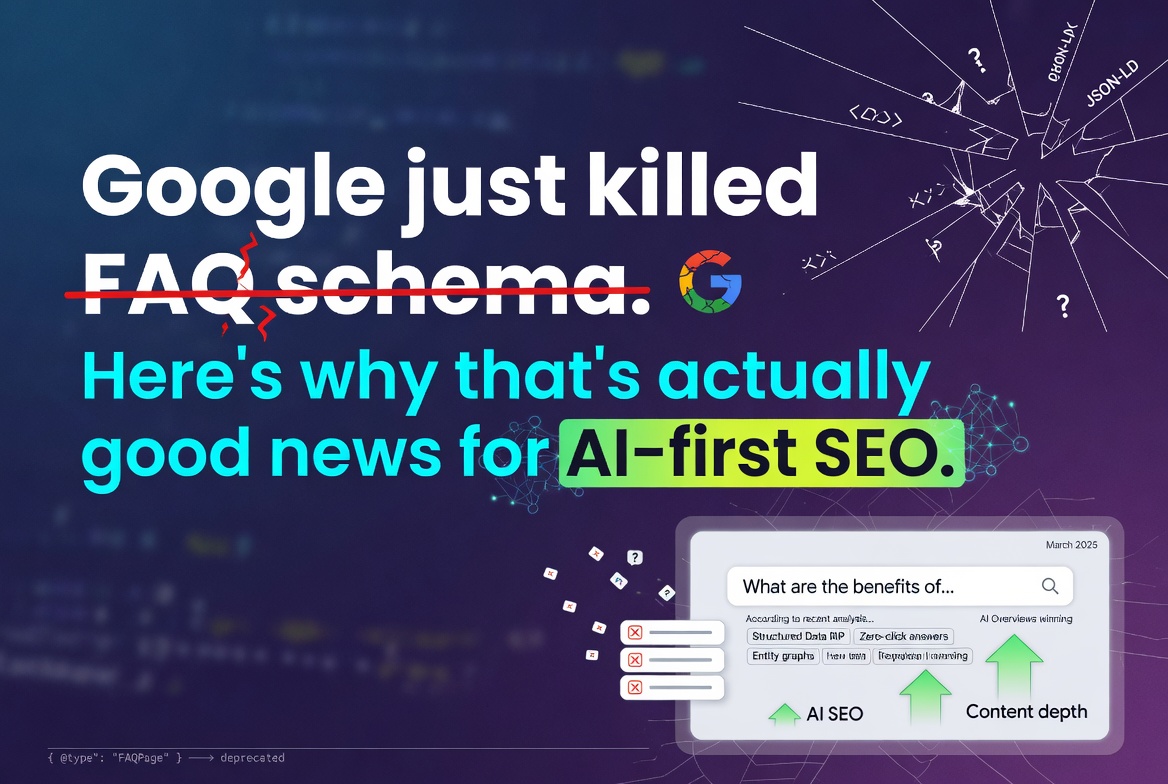
Google just killed FAQ schema. Here’s why that’s actually good news for AI-first SEO.
The deprecation of FAQ rich results isn’t a loss — it’s a confirmation that the rules of visibility have fundamentally changed. Here’s what to do instead.
As of May 7, 2026, Google has officially pulled the plug on FAQ rich results. The FAQ search appearance is going dark, the rich result report is disappearing from Search Console in June, and API support follows in August. For most SEOs, this was about as surprising as a rainout at a Seattle baseball game.
Because here’s the thing: Google wasn’t really reading FAQ schema anyway.
Reality check:
Reality check: Google’s own documentation restricted FAQ rich results to well-known, authoritative government and health sites. The bar was so high that less than 0.001% of sites ever qualified. For everyone else, it was markup that fired into a void.
So why did millions of sites implement it? Because agencies sold it, plugins automated it, and it felt like doing something productive. But the game has moved on — and the deprecation is actually clarifying.
What this actually means for LLM optimization
Here’s the insight most SEOs are missing: large language models do not care about your schema markup. At all. GPT-4o, Claude, Gemini, Perplexity — none of them are parsing your JSON-LD at inference time. They were trained on the semantic content of your pages, not the structured data decorating them.
What LLMs do care about, deeply, is how clearly and completely your content answers a question. This is the core shift in the new attention economy:
The energy your team was spending on FAQ schema implementation should be redirected entirely. Here’s the practical reframe: instead of asking “does this page have FAQPage markup?” ask “if an LLM reads only the text of this page, can it confidently extract a complete, accurate answer to the user’s question?”
What to actually do now
Your AEO checklist — Answer Engine Optimization
1. Write answers first, questions second.
Lead each section with the direct answer, then expand. LLMs prefer content that front-loads the answer, not content that builds to it.
2. Use conversational headers that mirror actual search queries.
“How long does X take?” outperforms “Timeline” as an H2 — for both LLMs and humans.
3. Build topical depth, not just topical breadth.
A cluster of 8 well-linked pages on one subject signals authority far more than 30 thin pages.
4. Prioritize clean HTML over clever markup.
Semantic HTML — proper heading hierarchy, clean paragraph structure, logical reading order — helps LLMs parse your content during training scrapes.
5. Get cited by sources LLMs trust — including Reddit.
Wikipedia, .gov, academic citations, and respected industry publications appear heavily in training data. But Reddit is equally important: it’s one of the most-scraped domains in LLM training corpora. Building a genuine presence on Reddit puts your expertise in front of both humans and the next generation of models trained on community knowledge.
6. Keep structured data that still matters.
Article, Organization, Product, HowTo, and Review schema still serve Google and can influence AI Overviews. Don’t throw out the entire playbook — just the part that was never working.
7. Add an llms.txt file to your site. New
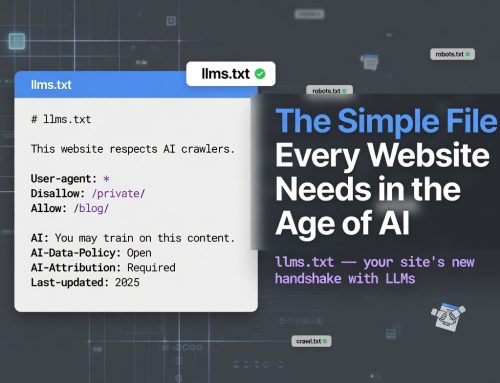
Just as robots.txt tells crawlers what to index, llms.txt is an emerging standard that tells AI models what your site is about, what to prioritize, and what to ignore. It’s early days — but being an early adopter signals authority and helps models accurately represent your content when users ask about your niche.
8. Monitor and measure your AI traffic.
You can’t optimize what you can’t see. Traditional analytics won’t show you how much of your traffic is coming from AI-driven referrals — users clicking through from ChatGPT, Perplexity, Claude, and Google’s AI Overviews. Dedicated AI visibility tools let you track which models mention your brand, how often, and in what context. This is the new rank tracking.
The bigger picture
Google’s FAQ deprecation is a symptom, not a cause. The underlying shift is that the interface between users and information is no longer just a list of blue links. AI answers, featured snippets, AI Overviews, and conversational search are becoming the primary surface. The optimization target has changed.
The sites that win in the next three years won’t be the ones with the most schema markup. They’ll be the ones that wrote the clearest, most trustworthy, most structurally coherent answers to real questions — and built enough authority that the models pulling from the web during training decided their content was worth including.
FAQ schema was always a surface-level trick. Its deprecation is a nudge to go deeper.
Let’s talk
Get in Touch