
Google says llms.txt won’t help or hurt your rankings — here’s what that actually means
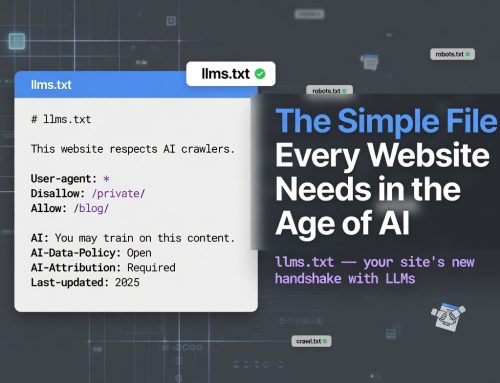
Google just put a stake in the ground. In an update to its AI optimization guide — in a section literally titled “mythbusting” — Google stated that Google Search doesn’t use llms.txt files, and that having one on your site won’t help or hurt your rankings.
If you’ve spent any time in r/SEO over the last year, you already know how fast that turned into a clean, viral headline: “llms.txt is dead.”
It isn’t. But the nuance got flattened, and the flattening is what’ll cost people. Here’s the honest version — what Google actually said, what the data actually shows, and what to do instead of arguing about a text file.
What Google actually said
Two lines do the work. Google wrote that you don’t need AI text files, markup, or Markdown to appear in Google Search, because “Google Search itself doesn’t use them.” And it added a note clarifying that maintaining llms.txt “for other services or systems that use these files” is completely fine — it “won’t harm (nor help)” your Google rankings, because Google Search ignores them.
Read that second sentence again, because it’s the part the headlines dropped. Google didn’t say llms.txt is useless. Google said Google Search ignores it — and then explicitly left the door open for other systems that do use these files.
That’s a narrow, precise claim. It’s being read as a universal one.
Google Search is not the entire AI ecosystem
This is the distinction that matters, and it’s the one most takes miss.
“Google Search,” including AI Overviews and AI Mode, runs on Google’s classic crawling, indexing, and ranking stack. Those features were built on top of the index you’ve optimized for since forever. Of course they don’t need a new file — they already have the whole web modeled. Google telling you llms.txt doesn’t move Google rankings is roughly as surprising as Google telling you a sitemap doesn’t move rankings either. True, and also not the point.
The AI ecosystem your brand actually lives in is bigger than Google Search. It includes ChatGPT, Perplexity, Claude, Gemini, and a growing layer of AI agents that fetch your pages to complete tasks. Those systems have their own retrieval logic. Collapsing all of that into “Google said it doesn’t work” is a category error.
So the real question isn’t “does Google use llms.txt?” (answer: no). It’s “does anything use it, and does it matter for me?” That question has a more honest — and more useful — answer.
The honest data: as an AI ranking signal today, it barely registers
I’m not going to sell you llms.txt as a citation hack, because the data doesn’t support it and your audience will check.
SE Ranking analyzed roughly 300,000 domains and found llms.txt currently has no measurable impact on how AI systems see or cite content. Separately, an analysis of more than 500 million LLM bot traffic events — filtered to the crawlers that actually drive AI citations (GPTBot, ClaudeBot, PerplexityBot, OAI-SearchBot, Google-Extended) — found the share of requests touching /llms.txt to be statistically negligible. The file is, for now, almost untouched by the bots that matter for AI search visibility.
And as of early 2026, no major AI company — OpenAI, Google, Anthropic, Perplexity, Meta, or Mistral — has publicly committed to reading llms.txt in production. GPTBot fetches it occasionally, but an occasional fetch is not the same as using a file to rank or cite you.
So if someone is selling you llms.txt as a guaranteed GEO ranking lever, they’re selling something the evidence doesn’t back up. Google’s note and the independent data are pointing in the same direction here.
Where llms.txt genuinely earns its place
Here’s the reframe that actually changes the math — and it’s why “llms.txt is dead” is the wrong conclusion.
The agentic and developer layer is where the file does real work today. When an AI coding assistant or agent fetches a page, it doesn’t read like a human — it pulls raw HTML stuffed with nav, cookie banners, scripts, and footers, then has to find the signal inside that noise within a fixed context window. A clean llms.txt gives those tools a low-noise map of your site. If your audience includes developers using Cursor or Claude Code, or you’re building toward agent-driven workflows, that’s a measurable improvement, not a theory.
It’s cheap forward-compatibility. A solid llms.txt is, at most, a half-day of work — minutes if you generate it. If and when major crawlers do start respecting it, being already-correct costs you nothing now. Notably, even as Google Search said it ignores the file, the Chrome team shipped an llms.txt check inside Lighthouse’s experimental audits. The signals from inside Google aren’t as unanimous as the headline suggests.
The honest summary: llms.txt is not (yet) a search play. It’s a developer-experience and optionality play. Low cost, real upside in specific cases, no downside per Google. That’s a perfectly good reason to have one — just not the reason the hype claimed.
The actual lesson: stop guessing, start measuring
Step back from the file for a second, because the file isn’t the real story. The real story is that the entire “should I do X for AI search?” debate is being argued with zero instrumentation. People are shipping tactics and hoping, then writing hot takes when Google clarifies one of them.
You can’t optimize what you can’t see. The only way to know whether llms.txt — or any AI tactic — is doing anything for your site is to watch two things directly:
- Which AI crawlers are actually hitting your site, and what they’re fetching. If GPTBot, ClaudeBot, and PerplexityBot never touch your
/llms.txt, you’ll know — instead of guessing from a blog post about someone else’s domains. - Whether AI systems are surfacing and citing you when people ask about your category.
That’s the gap AI View is built to close. Instead of betting on a file and waiting, you monitor AI crawler traffic and AI visibility in real numbers, and let your own data settle the debate for your own site.
What to actually do
- Don’t add llms.txt expecting Google rankings to move. Google told you plainly they won’t. Don’t let anyone bill it that way.
- Do add a clean llms.txt if you have a developer/agent audience or want cheap forward-compatibility. It’s near-zero cost and Google confirmed there’s no downside. Generate one free here — just keep it current, because a stale file pointing at dead pages works against you.
- Keep doing the SEO that’s always worked. Clear technical structure, genuinely useful, expert-led content. Google’s own guide says these foundations carry into AI search too.
- Instrument your AI visibility. Watch the crawlers and the citations. Replace “I think this helps” with “here’s what the logs say.”
Google didn’t kill llms.txt. It clarified one narrow thing about one search engine — and in doing so, reminded everyone that the strongest position in AI search isn’t having the right file. It’s having the data to know what’s actually working.
Want to see which AI crawlers are visiting your site and whether you’re showing up in AI answers? AI View monitors your AI traffic and visibility — and our free llms.txt generator gets you a clean file in minutes.